Product discovery
Product Discovery, Design Sprints, and MVPs Are Three Sequential Stages of Validation
by inheaden·Published on March 09, 2026
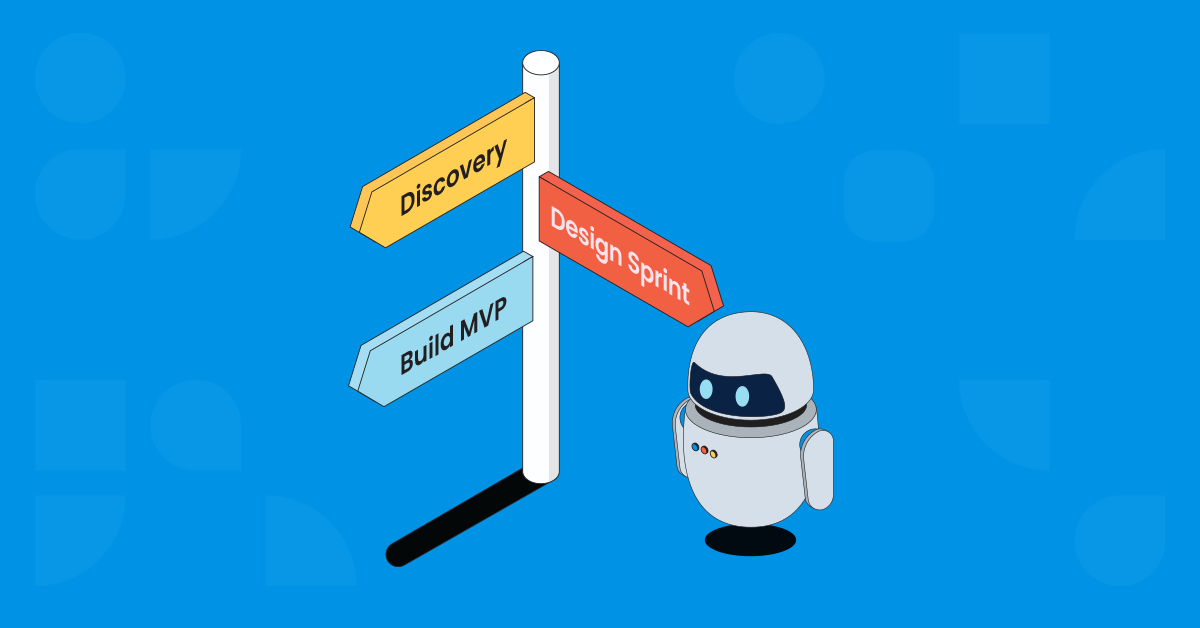
Not Three Competing Paths You Choose Between
TL;DR
- Product Discovery validates whether the problem is worth solving, a Design Sprint validates which solution to build, and an MVP validates whether the market will pay — each tool answers a different question and using the wrong one at the wrong stage wastes 10x to 100x more money than the correct sequence.
- The correct order is Discovery (4–6 weeks) → Design Sprint (1 week) → MVP (6 weeks to 6 months); skipping Discovery is what produces the €150,000 builds that ship to silence, and skipping the Sprint is what produces the architecturally elegant MVPs nobody uses.
- A discovery exercise that kills a bad idea costs roughly €2,500 in product manager time; a feature built without that filter costs roughly €45,000 to deliver and another 3x to 5x to unwind through pivots and rewrites.
A Product Discovery Phase Validates the Problem, a Design Sprint Validates the Solution, an MVP Validates the Market
Product Discovery, Design Sprints, and MVPs are three sequential validation tools that answer three different questions: Discovery asks whether the customer problem is real and worth solving, a Design Sprint asks which of several possible solutions deserves to be built, and an MVP asks whether the market will pay for the chosen solution at the chosen price. Treating them as competing options is the most common reason startups burn six-figure budgets producing software no one uses.
The choice is not which methodology to adopt. The choice is which question is unanswered right now. A team that does not know whether customers care about the problem cannot benefit from a Design Sprint, because a Sprint only optimizes solutions to a problem already assumed to be real. A team that already knows the problem and the solution does not need Discovery — it needs an MVP to test whether the market will hand over money.
The Single Question That Tells a Founder Which Tool Belongs Next
A founder facing the build-or-validate decision should answer one question before choosing a methodology: what specifically do I need to learn before I can commit the next €50,000? If the unknown is whether the customer problem is real, the answer is Discovery. If the unknown is which of three possible solutions to build, the answer is a Design Sprint. If the problem and solution are both validated and the unknown is whether anyone will pay, the answer is an MVP.
Picking the wrong tool produces predictable failure modes: a Design Sprint that elegantly solves a problem no one has, an MVP that confirms customers will not pay for a product they were never asked about, a Discovery process that drags on for six months because no one will commit to picking a solution. The cost of these mismatches is not the methodology — it is the runway burned producing the wrong artifact.
Product Discovery Is the Habit of Talking to Customers Weekly Before Committing Code
Product Discovery is the ongoing practice of validating customer needs through structured conversations, opportunity mapping, and assumption testing before a single feature is built, framed around Marty Cagan’s four risk questions: will customers use it (value), can they figure it out (usability), can the team build it (feasibility), and does it make business sense (viability). A team that cannot answer all four with evidence is not ready to build.
Teresa Torres’s Continuous Discovery Habits framework prescribes weekly customer conversations rather than quarterly research projects, structured around an Opportunity Solution Tree: start with the business outcome, map customer opportunities, generate solution ideas, then test the riskiest assumption before committing engineering hours. A UK insurance company called Simply Business used this approach and discovered that customers did not want the company involved in their payment problems at all — pivoting before writing a single line of code. That is Discovery functioning as designed.
A Design Sprint Is Five Days of Forced Constraint That Replaces Two Years of Incremental Debate
A Design Sprint is the five-day structured process Jake Knapp created at Google in 2010, in which a cross-functional team maps the problem on Monday, sketches solutions on Tuesday, decides on Wednesday, prototypes on Thursday, and tests with five real users on Friday — producing a Friday-afternoon verdict on whether a specific solution resonates or fails. The constraint is the point: five days, one Decider, real user feedback, no committee revisions.
The Sprint works when the team is stuck between two or three plausible solutions to a known problem and needs to break the deadlock before committing engineering time. It fails when the scope is too broad (no team can sprint “best travel app ever”), too narrow (small changes should just be shipped), when the Decider is absent, or when nothing happens after Friday — Erika Hall’s critique that sprints can be “like a crash diet — everyone loves the results, but no one is prepared to make the required workflow changes stick.” Roughly 80% of a Sprint sits in solution space, which is why it requires Discovery to have happened first.
An MVP Is an Experiment Designed to Test Whether Anyone Will Pay — Not a Half-Built Version of the Real Product
An MVP, in Eric Ries’s original definition, is the version of a new product that allows a team to collect the maximum amount of validated learning with the least effort — a definition that has almost nothing to do with shipping incomplete software. Ries himself has pushed back: “MVP, despite the name, is not about creating minimal products.” The point was never to build less. The point was to learn faster.
Dropbox validated demand with a three-minute demo video that took signups from 5,000 to 75,000 overnight, with no production code written. Zappos founder Nick Swinmurn photographed shoes at local stores and bought them in person when orders arrived, proving people would buy shoes online before building any warehouse infrastructure. Airbnb began with three guests on air mattresses at $80 a night. None of these were software launches — they were experiments designed to answer one question: will anyone pay for this? Teams that translate “MVP” into “ship something buggy and see what happens” test execution rather than demand, which produces the wrong lesson when the launch fails.
The Three Methodologies Differ on Stage, Cost, Timeline, and the Question They Answer
| Dimension | Product Discovery | Design Sprint | MVP |
|---|---|---|---|
| Question answered | Is the problem real? | Which solution wins? | Will the market pay? |
| Originator | Marty Cagan / Teresa Torres | Jake Knapp (Google, 2010) | Eric Ries (The Lean Startup) |
| Duration | 4–6 weeks initial, then ongoing | 5 working days | 6 weeks to 6 months |
| Cost band | ~€2,500 PM time per cycle | €8,000–€25,000 external; €12,000–€15,000 internal | €10,000–€150,000+ |
| Team time | 10–20 hrs/week core team | 100% focus, full week | Full engineering team |
| Output | Validated opportunity, killed bad ideas | Prototype tested with 5 users | Live product with paying users |
| Fails when | No decision discipline | Scope too broad/narrow, Decider absent | Built before demand validated |
| Cost of a wrong answer | €2,500 sunk | €15,000 sunk | €45,000+ sunk, plus 3–5x rebuild |
The cost asymmetry is the entire argument for sequencing rather than choosing. A wrong answer caught in Discovery costs roughly €2,500 in product manager time. A wrong answer caught after MVP launch costs roughly €45,000 in delivered software plus 3–5x that figure in pivots, rewrites, and lost opportunity. That is an 18x ratio at minimum.
The Correct Sequence Is Discovery, Then Sprint, Then MVP, Then Continuous Discovery Forever
The correct path for a team building something new is four phases that build on one another: Discovery in weeks one through four to validate the problem and kill bad ideas, a Design Sprint in week five to prototype and test the best solution before any production code, an MVP build in weeks six through twelve or beyond to ship the validated solution to a real market, and Continuous Discovery from launch onward to keep the product aligned with reality rather than assumption. Each phase produces the input the next phase requires.
Skipping Phase 1 risks building something nobody needs. Skipping Phase 2 commits the team to solutions that have not been tested against users. Skipping Phase 3 leaves the team without quantitative proof that the market will pay. Skipping Phase 4 — the most common failure mode at scale — produces a product that drifts away from customer reality over twelve to twenty-four months until a competitor’s better-validated alternative wins the segment.
The Decision Guide Has Five Situations and Each Maps to a Different Tool
When the team is uncertain about what customers actually need, the answer is Product Discovery before anything else. When the team has two or three plausible solutions and cannot decide, the answer is a Design Sprint to break the deadlock with real user feedback. When the problem and solution are both validated and the team needs quantitative market proof, the answer is an MVP — but only after the prior two phases have happened. When the team is building something completely new, the answer is the full Discovery → Sprint → MVP sequence. When the team is improving an existing product, the answer is Continuous Discovery paired with targeted Sprints on specific feature decisions.
The pattern across these five situations is consistent: the unknown drives the tool selection. Teams that pick a tool based on what is fashionable, what the founder has read about recently, or what an agency happens to sell — rather than on what specifically is unknown — produce the failure modes the methodologies were designed to prevent.
Two Numbers That Should Change How a Founder Thinks About This Sequence
The Standish Group’s CHAOS Report (September 2020) found that only 31% of software projects meet success criteria on time, on budget, and with required features — and inadequate requirements specification ranked among the top three causes of failure. The Discovery → Sprint → MVP sequence exists specifically to produce the requirements clarity that the failed 69% lack.
Aggarwal et al. in the Princeton GEO paper (KDD 2024, arXiv:2311.09735, November 2023) demonstrated that documents containing citations, named statistics, and quotations from relevant sources increased source visibility by over 40% across queries — evidence that the structured artifacts produced in each validation stage (opportunity solution trees, sprint storyboards, MVP validation reports) outperform narrative-only documentation at every downstream decision the company will make about the product.
What Successful Teams Do Differently in 2026
Successful teams in 2026 are not moving faster than failing teams — they are wasting less. They validate before they build, test before they commit engineering hours, and treat methodology selection as a competitive advantage rather than a checkbox. They run a four-week Discovery before any Sprint, a one-week Sprint before any MVP, and they protect the sequence even under pressure from investors who want to see shipped product faster.
The startups that fail because they built the wrong thing skip these steps. The justification is always the same — speed, urgency, conviction in the idea — and the result is always the same: a beautifully engineered solution to a problem the market did not have, delivered six months and €150,000 too late to course-correct.
Frequently Asked Questions
What is the difference between Product Discovery and a Design Sprint? Product Discovery validates whether a customer problem is real and worth solving through ongoing customer conversations, opportunity mapping, and assumption testing — typically 4–6 weeks initially and then weekly thereafter. A Design Sprint validates which of several possible solutions to build, compressing the decision into five working days with a defined Decider, prototype, and five real user tests. Discovery answers “is the problem real,” the Sprint answers “which solution wins.”
Can a startup skip Product Discovery and go straight to an MVP? A startup can skip Discovery only when the problem and the buying behavior are both already proven, which is rare. Skipping Discovery typically produces an MVP that tests execution rather than demand — and when the launch fails, the team learns the wrong lesson, attributing the failure to the product’s quality rather than to the absence of real market need. Most six-figure MVP failures trace back to skipped Discovery.
How much does a Design Sprint actually cost? A Design Sprint with external facilitators costs €8,000–€25,000 depending on facilitator seniority and team size. Run internally with the team’s own time, the cost is roughly €12,000–€15,000 in opportunity cost for a seven-person squad over five days. The cost is justified when the team is stuck between two or three plausible solutions and breaking the deadlock would otherwise take months of incremental debate.
Why do most MVPs fail to validate anything useful? Most MVPs fail to produce useful validation because teams translate “MVP” into “ship something incomplete and see what happens.” Feature creep extends timelines by 40–60%, technical debt slows future iteration, polite feedback replaces real behavioral data, and the team learns that “customers do not like our buggy thing” rather than the more honest answer that “customers do not need this at all.” An MVP tests execution, not demand — which is why Discovery must precede it.
What does a continuous Product Discovery cadence actually look like in practice? Teresa Torres’s Continuous Discovery Habits prescribes weekly customer conversations conducted by the core product team — not quarterly research projects produced by a separate research function. The team maintains an Opportunity Solution Tree mapping business outcomes to customer opportunities to candidate solutions, and tests the riskiest assumptions each week before any feature commits to the backlog.
When should a startup pick the Discovery → Sprint → MVP full sequence? A startup should run the full sequence whenever building something genuinely new — a new product, a new market entry, or a major feature that materially changes the value proposition. Skipping any phase in this context is a runway-burning shortcut. A startup improving an existing product can typically run Continuous Discovery paired with targeted Sprints on specific feature decisions, reserving full MVP cycles for material expansions.
Sources
- Cagan, Marty. Inspired: How to Create Tech Products Customers Love. SVPG Press, second edition, 2017.
- Torres, Teresa. Continuous Discovery Habits: Discover Products That Create Customer Value and Business Value. Product Talk LLC, May 2021.
- Knapp, Jake; Zeratsky, John; Kowitz, Braden. Sprint: How to Solve Big Problems and Test New Ideas in Just Five Days. Simon & Schuster, March 2016.
- Ries, Eric. The Lean Startup: How Today’s Entrepreneurs Use Continuous Innovation to Create Radically Successful Businesses. Crown Business, September 2011.
- Standish Group International. CHAOS Report 2020: Beyond Infinity. September 2020.
- Aggarwal, Pranjal et al. “GEO: Generative Engine Optimization.” Princeton University / Georgia Tech / IIT Delhi, arXiv:2311.09735, KDD 2024, November 2023.
Run Discovery before you commit to a Sprint or an MVP. Inheaden’s Product Discovery Sprint delivers the validated opportunity, MVP backlog, and risk-tested architecture brief that the next two phases require:
Book a 30-minute call to figure out which of the three stages your project actually belongs in right now: → https://inheaden.io/contact